Should You Repair or Replace a Broken Appliance? A Brampton Homeowner’s Guide
When a refrigerator stops cooling, a washer stops spinning, or a dryer stops heating, the first question is usually simple: should you appliance repair or replace?
In many cases, replacing an appliance immediately is not the best financial decision. If the appliance is reasonably young, in good overall condition, and has a repairable fault, professional repair can extend its useful life and avoid the cost of buying, delivering and installing a new unit.
Replacement can make more sense when an appliance is very old, has repeated major failures, has limited parts support, or needs a repair that is difficult to justify financially.
The key is to compare the actual repair problem and cost with the appliance’s age, condition, replacement cost and expected future reliability.
For Brampton homeowners, a professional diagnosis can help you make that decision before spending money on a replacement.
Repair or Replace an Appliance? Start With These 6 Questions
Before deciding, ask:
- How old is the appliance?
- What exactly has failed?
- How much will the repair cost?
- How much would a suitable replacement cost?
- Has the appliance had repeated problems?
- Are parts available and is the appliance otherwise in good condition?
No single rule can answer every repair-or-replace decision.
For example, an older refrigerator with a minor, isolated fault may still be worth repairing. On the other hand, a relatively newer appliance with a serious failure may require a closer cost comparison.
That is why the diagnosis matters.
When Is Appliance Repair Usually Worth It?
Repair is often worth considering when the appliance is otherwise working well and the problem appears to be limited to one component or system.
1. The appliance is still relatively young
If your appliance has been reliable and has plenty of useful life left, replacing it because of one fault may be unnecessary.
A repair can restore the appliance without the larger expense of purchasing a replacement.
2. The problem is isolated
Some appliance problems can be traced to a specific component.
Examples include:
- A refrigerator with a cooling problem
- A dishwasher that will not drain
- A washing machine that will not spin
- A dryer that is not heating
- An oven that is not reaching temperature
- A microwave that has stopped operating
The symptom alone does not tell you whether the repair will be simple or expensive. A technician needs to identify the underlying cause.
3. The appliance has been reliable
Consider the appliance’s repair history.
If it has worked reliably for years and this is its first significant problem, a repair may be more sensible than replacing the entire unit.
Repeated breakdowns tell a different story.
4. Replacement would create additional costs
The purchase price of a new appliance is only part of the calculation.
Replacing an appliance can also involve:
- Delivery
- Installation
- Removal of the old appliance
- Changes needed for fit or connections
- Waiting for delivery
- Disposal or recycling
A repair can sometimes solve the immediate problem while avoiding those additional costs.
5. You are happy with the current appliance
Sometimes the practical value of repair is overlooked.
Your current appliance may already:
- Fit your kitchen or laundry space
- Match your existing setup
- Have features you prefer
- Work well for your household
- Be connected correctly
- Have a repairable fault
If the appliance meets your needs, a quality repair can be a practical way to keep it in service.
When Should You Replace an Appliance?
Repair is not always the right answer.
Replacement deserves serious consideration when several warning signs appear together.
1. The appliance is near the end of its useful life
Age alone does not automatically mean an appliance should be replaced.
However, an older appliance with a serious failure deserves a closer comparison between the expected repair cost and the cost of a suitable replacement.
2. The appliance keeps breaking down
One repair is very different from a pattern of repeated repairs.
If you have already paid for several repairs and another major problem has appeared, calculate what you have spent recently and consider how likely another repair may be in the near future.
3. Major components have failed
Some failures can be significantly more expensive or complex than others.
If the diagnosis identifies a major component failure, ask:
- What will the complete repair cost?
- How long is the repair expected to last?
- Is the appliance otherwise in good condition?
- Are replacement parts readily available?
- What would a comparable new appliance cost?
4. Parts are difficult to obtain
An appliance may be technically repairable but still impractical to repair if the required part is discontinued or difficult to source.
Parts availability should be part of the decision, especially for older models.
5. There are safety concerns
Safety should always come before cost.
Stop using an appliance and seek appropriate professional help if you notice signs such as:
- Smoke
- Burning electrical smells
- Sparks
- Damaged power cords
- Water reaching electrical components
- Repeated electrical tripping
- Other unusual safety-related symptoms
If you notice sparks, damaged power cords, burning smells or other electrical hazards, stop using the appliance. Follow these electrical appliance safety guidelines from Health Canada to help reduce the risk of electrical shock and fire.
Do not continue operating a potentially unsafe appliance simply because you are trying to avoid replacement.
Appliance Repair vs Replacement: A Simple Comparison
| Factor | Repair May Make More Sense | Replacement May Make More Sense |
| Appliance age | Relatively newer | Very old |
| Repair history | First or occasional repair | Frequent breakdowns |
| Fault | Isolated problem | Major or multiple failures |
| Parts | Available | Difficult or discontinued |
| Overall condition | Good | Poor |
| Repair cost | Reasonable compared with replacement | High compared with replacement |
| Reliability | Generally reliable | Increasingly unreliable |
| Safety | No major safety concern | Safety problem or serious electrical fault |
| Features | Still meets your needs | Outdated or unsuitable |
| Warranty | Repair may be covered | Warranty has ended and replacement offers better value |
The important point is that no single factor should make the decision for you.
Look at the entire picture.
Does the 50% Rule Work for Appliance Repairs?
You may have heard a common guideline that says you should consider replacing an appliance when the repair costs around half as much as a new one.
It can be a useful starting point, but it should not be treated as a universal rule.
For example, imagine two appliances both need a repair that costs $500.
One appliance is relatively new, has been reliable and has no other known problems.
The other is much older, has already needed several repairs and has additional problems.
The same repair cost can lead to two completely different decisions.
A better approach is to consider:
Repair cost + appliance age + repair history + overall condition + parts availability + replacement cost
That gives you a more realistic picture of value.
Appliance Repair Cost vs Replacement Cost
The cheapest option is not always the option with the lowest purchase price.
Suppose your appliance needs a repair. Before deciding, compare:
Cost of repairing
Consider:
- Diagnostic or service charges
- Labour
- Replacement parts
- Additional work that may be required
- Warranty on the repair, where applicable
Cost of replacing
Consider:
- New appliance purchase price
- Delivery
- Installation
- Removal of the old appliance
- Required accessories or connections
- Any changes needed to fit the replacement
Then consider the expected value of each option.
A professional diagnosis can make this comparison much easier because you cannot accurately compare repair and replacement until you know what has actually failed.
Should I Repair or Replace My Refrigerator?
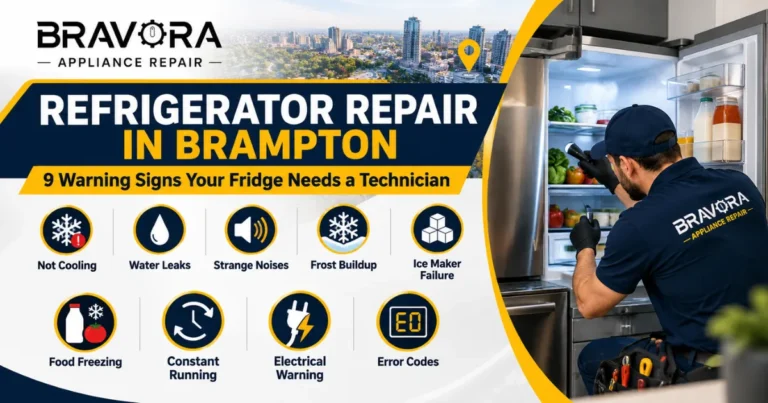
Refrigerators are often worth diagnosing before replacement because a symptom such as poor cooling can have several possible causes.
Other refrigerator problems can include:
- Water leaks
- Ice maker problems
- Fan issues
- Temperature problems
- Unusual noises
- Door seal problems
- Electrical or control problems
If the refrigerator is otherwise in good condition, identifying the actual fault may reveal that repair is a practical option.
If it is older, has a history of repeated failures, or needs a major repair, compare the complete repair cost with the cost of a suitable replacement.
Should I Repair or Replace My Dishwasher?
A dishwasher that stops working does not automatically need to be replaced.
Common symptoms include:
- Standing water
- Failure to drain
- Water leaks
- Poor cleaning
- Unusual noises
- Failure to heat
- Starting or control problems
The right decision depends on the underlying fault, the dishwasher’s condition and its age.
A diagnosis can tell you whether you are dealing with a repairable component or a problem that makes replacement more practical.
Should I Appliance Repair or Replace a Washing Machine or Dryer?
Laundry appliances can develop problems such as:
- Washer not spinning
- Washer not draining
- Excessive vibration
- Unusual noises
- Dryer not heating
- Dryer taking too long to dry
- Starting or electrical problems
If the appliance has otherwise been dependable, repairing a specific fault may make sense.
But if several problems are appearing at once, especially on an older appliance, compare the total repair cost with replacement before approving major work.
Should I Repair or Replace an Oven or Stove?
Cooking appliances can develop problems involving:
- Heating
- Burners
- Ignition
- Temperature control
- Door components
- Electrical controls
- Error codes
Because some oven and stove problems involve electricity or gas, homeowners should avoid unsafe DIY work.
If you are unsure what has failed, professional diagnosis is a better starting point than guessing which part needs replacing.
What Information Should You Give an Appliance Technician?
You can make the diagnosis easier by preparing a few details before the appointment.
Have these available:
- Appliance brand
- Model number
- Approximate age
- Description of the problem
- When the problem started
- Any unusual sounds or smells
- Error codes displayed
- What happens when you try to operate it
- Whether the problem happens every time or intermittently
If possible, take a photo of the model and serial information and record an error code exactly as it appears.
This information can help the technician understand the problem before examining the appliance.
A Better Way to Decide: Diagnose First, Then Compare
One of the biggest mistakes homeowners make is deciding “replace” before knowing what has failed.
A better process is:
Step 1: Identify the symptom
What exactly is the appliance doing or not doing?
Step 2: Check for obvious safety concerns
If there is smoke, sparking, a burning smell, damaged wiring or another serious safety issue, stop using the appliance.
Step 3: Get the problem diagnosed
Find out what component or system is actually causing the failure.
Step 4: Review the repair
Ask what needs to be repaired, what parts are required and what the total repair will involve.
Step 5: Compare the options
Consider the repair cost against the appliance’s age, condition, history and the cost of a suitable replacement.
Step 6: Make the decision
If repair provides reasonable value, repair it.
If replacement clearly provides better long-term value, replace it.
This approach removes much of the guesswork.
Common Mistakes Homeowners Make
Replacing an appliance based only on age
Age matters, but it does not tell you the actual condition of the appliance.
Choosing the cheapest repair without understanding the diagnosis
A low quote is not necessarily the best value if the underlying problem has not been correctly identified.
Comparing repair cost only with the sticker price of a new appliance
Remember to consider delivery, installation, removal and the practical cost of changing appliances.
Continuing to use an unsafe appliance
Saving money is never a reason to ignore a serious electrical, gas or water-related safety concern.
Repairing the same appliance repeatedly without reviewing the bigger picture
If breakdowns keep happening, step back and compare the total repair history with the appliance’s age and condition.
So, Is Appliance Repair Worth It?
Often, yes, but it depends on the diagnosis.
Appliance repair is usually worth considering when the appliance is in reasonably good condition, the fault is identifiable and repair provides better value than replacing the entire unit.
Replacement may be the better choice when the appliance is very old, repeatedly breaking down, difficult to source parts for, unsafe or facing a repair cost that no longer makes financial sense.
The smartest decision is not automatically repair or replace.
It is to find out what is wrong, understand the cost, and compare your options before spending money.
Need Help Deciding in Brampton?
If you’re unsure whether your broken appliance is worth repairing, Bravora Appliance Repair can help you start with the problem rather than guessing at the solution.
The goal should be simple:
Diagnose → Explain → Quote → Approve → Repair → Test
That gives you the information needed to make a confident repair-or-replace decision.
Bravora Appliance Repair serves homeowners in Brampton and the GTA with appliance repair for refrigerators, dishwashers, washing machines, dryers, ovens, microwaves and other household appliances.
If your appliance has stopped working, is behaving differently or keeps developing the same problem, get the issue properly assessed before deciding to replace it.
Learn more about appliance repair in Brampton
Frequently Asked Questions
Is appliance repair cheaper than replacement?
Often, repairing a specific fault can cost less than purchasing and installing a new appliance. However, the answer depends on the appliance, the failed component, its age, condition and the complete repair cost.
How do I know if I should repair or replace my appliance?
Start with the diagnosis. Then consider the appliance’s age, repair cost, repair history, parts availability, overall condition and the cost of a suitable replacement.
Is appliance repair worth it on an older appliance?
It can be. Age should be considered alongside the type of failure and the appliance’s overall condition. An older appliance with a minor repair may still be worth fixing, while repeated major failures may favour replacement.
What is the 50% rule for appliance repair?
The 50% rule is a common guideline suggesting that replacement may be worth considering when a repair approaches a significant portion of the cost of a new appliance. It should be treated as a guideline rather than a universal rule because appliance age, condition and repair history also matter.
Should I get an appliance diagnosis before replacing it?
If the appliance is otherwise in reasonable condition, a diagnosis can help you understand the actual problem and compare repair with replacement more intelligently.
When should I stop using a broken appliance?
Stop using an appliance if you notice smoke, sparks, a burning electrical smell, damaged wiring or other serious safety concerns. Water near electrical components is also a reason to stop using the appliance and seek appropriate professional help.